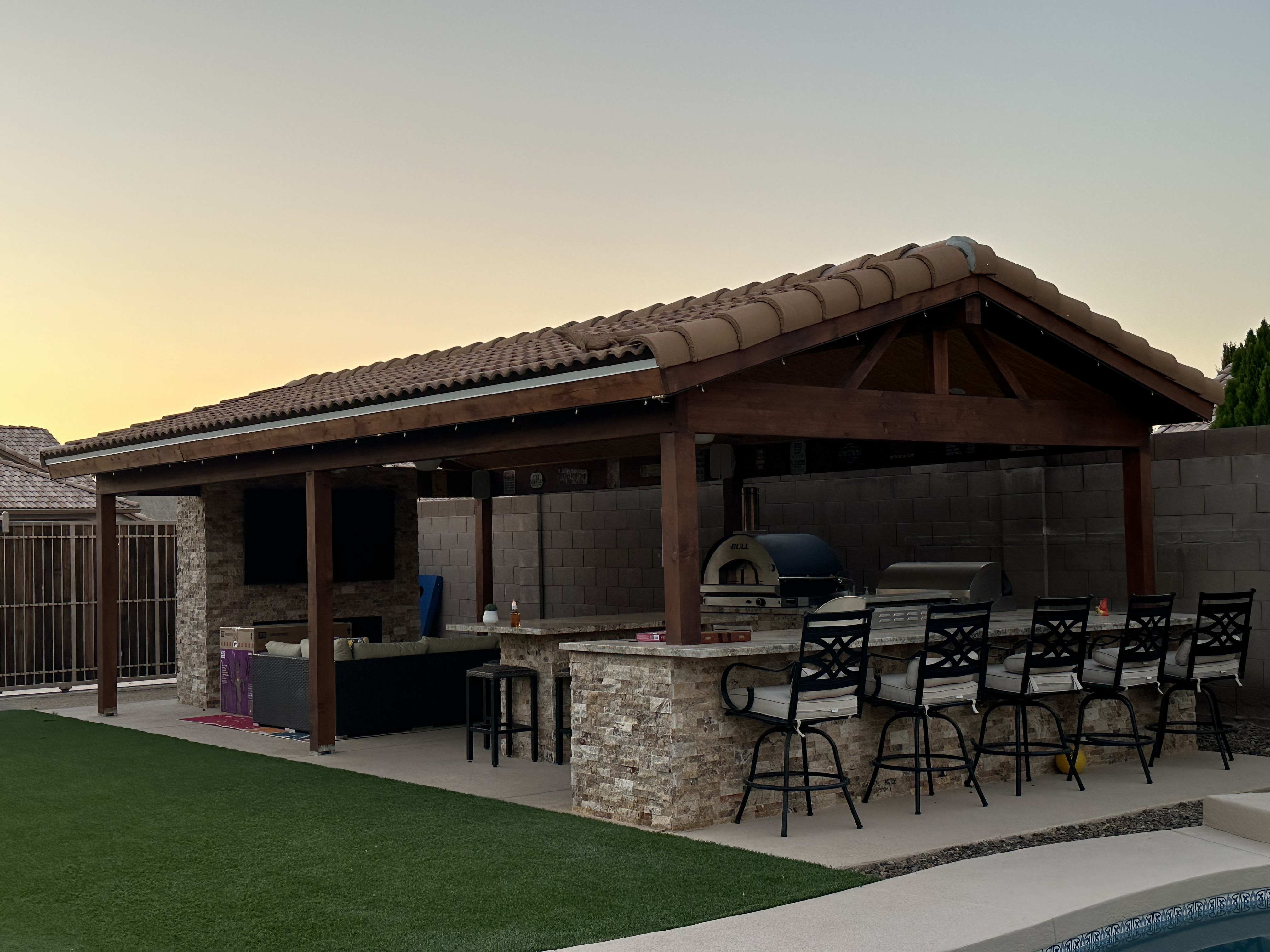
Outdoor kitchens are one of the best investments an Arizona homeowner can make. When done right, they become the center of every backyard gathering. When done wrong, they deteriorate quickly, feel unusable in summer heat, and cost far more to repair than they ever saved upfront.
Here are the five mistakes we see most often — and how Creative Edge designs around each one.
Mistake #1: Using the Wrong Materials for Arizona's Climate
This is the most common and most costly mistake. Arizona isn't just hot — it's relentlessly hot, UV-intense, and thermally punishing. Materials that work fine in mild climates fail quickly here.
- Untreated wood framing: Warps, cracks, and becomes a termite haven. All Creative Edge outdoor kitchens use steel framing or cement board construction
- Cheap tile countertops: Porous tiles absorb moisture and crack from thermal expansion. We use natural stone or high-density porcelain rated for extreme temperature ranges
- Standard stainless steel: 304-grade stainless oxidizes in UV-heavy environments. We specify 316-grade or powder-coated aluminum components for outdoor use
- MDF or composite cabinets: They fail fast outdoors. Every cabinet and door we install is designed for exterior rated use
Ask your contractor: "What's the framing material?" If the answer is wood, walk away. In Arizona, wood framing in an outdoor kitchen is a warranty-voiding and structurally risky decision.
Mistake #2: No Shade — or Not Enough of It
We've seen gorgeous outdoor kitchens installed without adequate shade — and they're essentially unusable from May through September. Arizona's summer sun is brutal, and without overhead shade, your outdoor kitchen becomes an oven.
At Creative Edge, we design shade into every outdoor kitchen project. Whether it's a custom pergola, attached patio cover, or shade sail, overhead coverage isn't optional in the Arizona desert — it's a functional requirement. We also factor in prevailing wind direction and time-of-day sun angle to maximize shade when you actually use the space (evenings).
Mistake #3: Undersized Counter and Prep Space
Homeowners consistently underestimate how much counter space they actually need. A built-in grill takes up 30–36 inches of counter width on its own. Add a side burner, and you've used 48–60 inches — before you have anywhere to prep, plate, or set drinks.
Our standard recommendation is a minimum of 8 linear feet of total counter space for a functional outdoor kitchen — with at least 24 inches of clear prep space on each side of the primary grill. If you're entertaining regularly, go bigger. Counter space is always the first thing people wish they had more of.
Mistake #4: Planning Appliances Before Planning Infrastructure
Outdoor kitchens need gas lines, electrical circuits, and often water supply. The time to plan for these is before the foundation is poured, not after. We regularly see homeowners who added a grill island themselves only to discover they need to cut through finished concrete to run a gas line they forgot to plan for.
Every Creative Edge project starts with infrastructure planning:
- Gas line sizing and routing — before any concrete or masonry work begins
- Dedicated 20-amp circuits for refrigerators, lighting, and outlets — run in conduit rated for outdoor use
- Water supply and drain lines if a sink is included
- Conduit sleeves for future additions even if not used immediately
Mistake #5: Forgetting About Nighttime Lighting
Outdoor kitchens in Arizona get used most in the evening — that's when the heat breaks and the space becomes enjoyable. Yet lighting is almost always an afterthought. Task lighting over the grill and prep area, ambient lighting in the seating zone, and accent lighting on the structure itself transform the space after dark.
We design lighting into every outdoor kitchen, using 12V low-voltage LED systems that are weatherproof, energy-efficient, and timer-controllable. It's one of the highest-return additions to any outdoor kitchen design.
Planning an Outdoor Kitchen?
We'll design around every one of these pitfalls — and show you exactly what we're doing and why before a single block is laid. Free on-site consultation, no obligation.
Schedule Your Free Consultation →