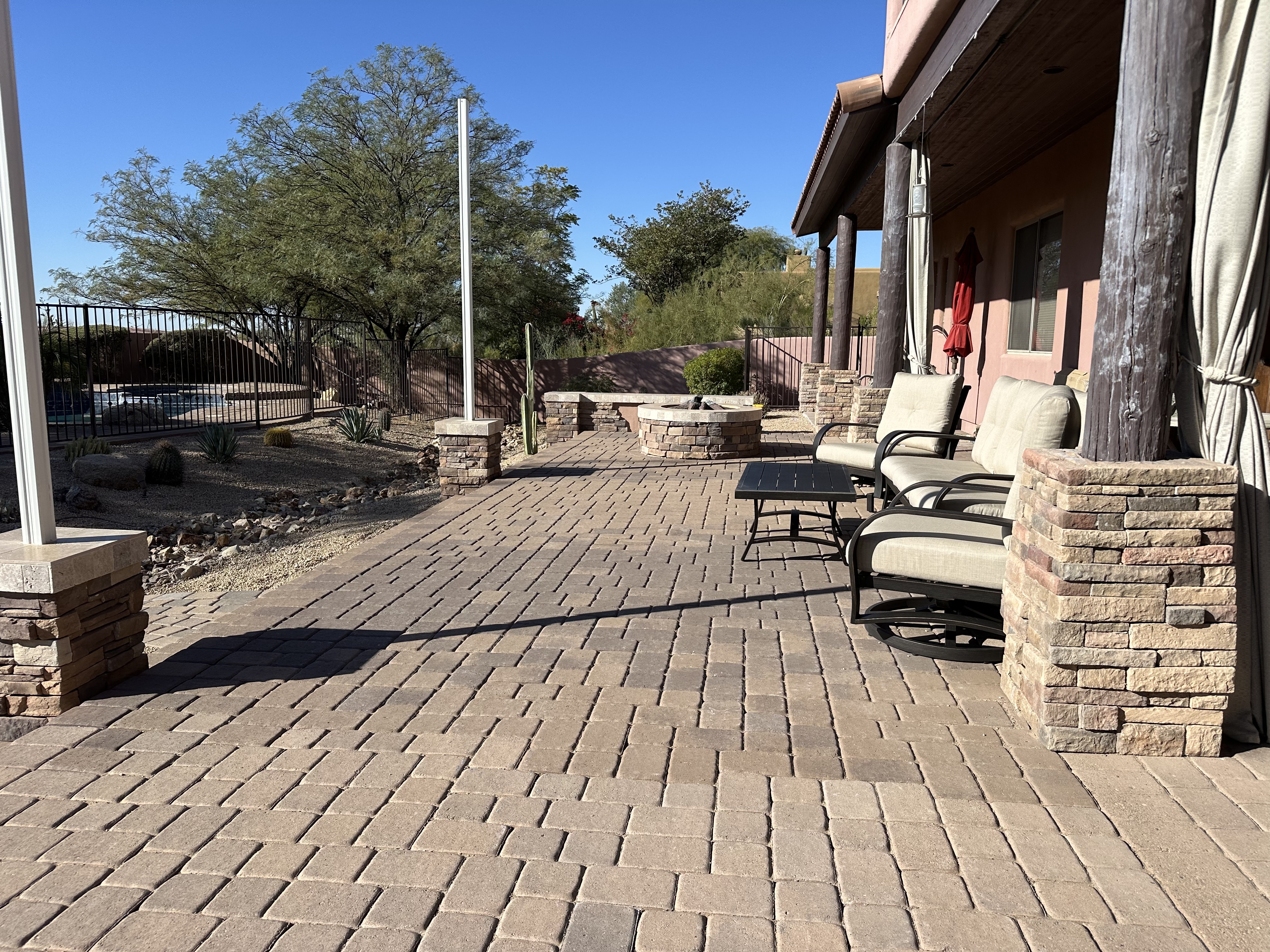
The honest answer to "how long do pavers last?" is: it depends entirely on the installation, not the pavers. High-quality concrete and natural stone pavers don't fail. What fails is the base they're sitting on, the drainage around them, and the installation technique used to lay them.
Here's what you need to know to get the most from your paver investment in Arizona.
Lifespan of Pavers Done Right
Concrete pavers installed correctly in Arizona can be expected to last 25–40 years before they require any significant attention. The concrete itself is dense, UV-resistant, and rated for our thermal environment. The limiting factors are always the base and drainage — not the paver material.
Natural stone pavers — travertine, flagstone, and granite — are even longer-lived. Roman-era travertine is still in service in Italy. With proper installation and periodic sealing, natural stone pavers in Arizona are legitimately a multi-generational investment.
What Causes Pavers to Fail Early in Arizona
When we get calls about sinking, cracking, or shifting pavers, the cause is almost always one of these four things:
1. Insufficient or Improperly Compacted Base
The most common failure mode. A base that wasn't compacted in proper lifts, or that was too thin for the load it bears, will settle unevenly over time. Pavers follow the base — where the base drops, the pavers go with it.
2. Drainage Problems
Water is the enemy of every paver installation. When water can't drain away from the installation — because the grade is wrong, drains are missing, or the base traps water — it softens the sub-base during monsoon events and causes progressive settling. In Arizona, monsoon drainage planning is critical, not optional.
3. Sand Bed Migration
The 1" concrete sand bedding layer between the ABC base and the pavers is essential — but it can migrate out of position over time if the perimeter edge restraint fails or drainage pushes it laterally. Once the bedding sand shifts, the pavers above follow.
4. No Edge Restraint
Every properly installed paver field needs a solid perimeter edge restraint — whether that's a concrete border, a steel spike edge, or a structural wall. Without it, the perimeter pavers slowly migrate outward over years of thermal expansion and foot traffic, causing the entire installation to gradually spread and lose level.
Signs Your Pavers Were Installed Incorrectly
- Visible settling or sinking within 1–3 years of installation
- Pavers rocking or moving underfoot
- Water pooling on the surface instead of draining away
- Sand washing out from between joints during rain events
- Perimeter pavers spreading outward from the field
- Weeds growing up through joints within the first season
If you see any of these signs within 5 years of installation, the base was not done correctly. Don't add more sand on top — address the base. We offer professional assessments for problem paver installations throughout the West Valley.
Our Warranty — and What It Means
Creative Edge backs every paver installation with a 5-year labor warranty. That warranty only makes sense because of how we build the base: compacted ABC in proper lifts, correct drainage slope, perimeter edge restraint, and geotextile fabric where soil conditions warrant it. We're not worried about callbacks because we build it right the first time.
Getting Paver Quotes? Ask About the Base.
The difference between a 5-year installation and a 25-year installation is almost entirely in what happens below the surface. We'll show you exactly how we build ours — free consultation.
Schedule a Free Paver Consultation →