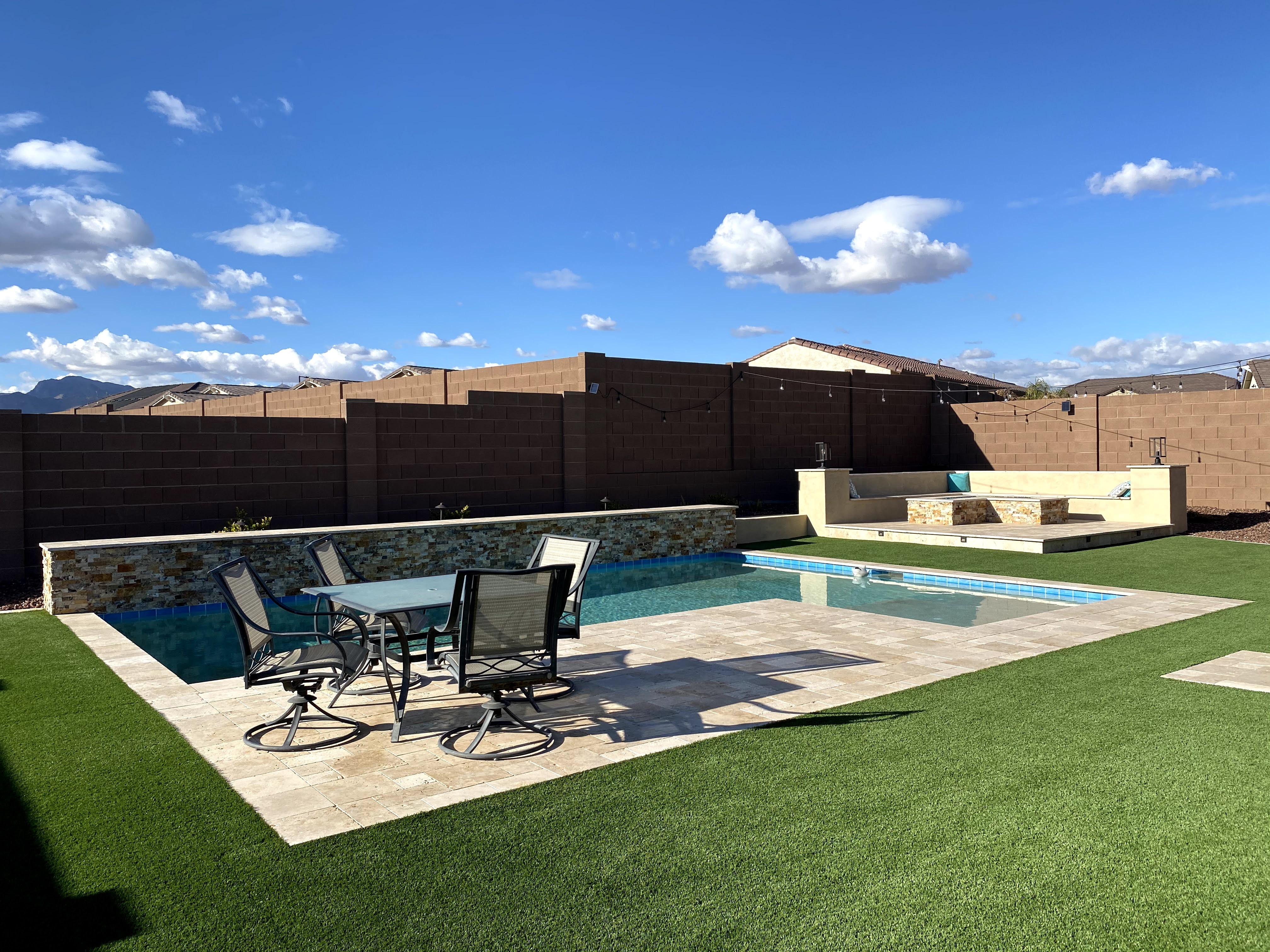
Walking into a turf showroom can be overwhelming. There are dozens of products, all looking similar, at wildly different price points. Worse, most of the sales advice you'll receive is generic — not tailored to the specific demands of the Sonoran Desert, where ground temperatures can exceed 180°F on a summer afternoon.
Here's what actually matters when choosing artificial turf for an Arizona installation.
1. UV Stabilization: Non-Negotiable in Arizona
Arizona receives over 300 days of sunshine per year. UV radiation degrades plastic — including the polyethylene and polypropylene fibers used in artificial turf. Cheap turf without proper UV inhibitors will fade, become brittle, and shed microfibers within a few years of Arizona sun exposure.
Look for turf specifically rated with UV stabilizers built into the fiber — not sprayed on after the fact. Reputable manufacturers will specify their UV rating in the product spec sheet. Any turf we install at Creative Edge carries a minimum 15-year UV and color warranty.
Ask your installer: "What is the UV warranty on this specific product, and is it backed by the manufacturer?" If they can't produce a spec sheet, walk away.
2. Blade Shape Affects Heat Retention
This is something most homeowners don't know: the shape of the individual turf blade significantly affects how hot the turf gets. Flat ribbon blades trap and hold heat more than W-shaped, C-shaped, or S-shaped blades, which allow more airflow through the turf pile.
In Arizona, we recommend W or S-blade turf profiles. The geometry creates micro-gaps in the pile that allow heat to dissipate more efficiently — lowering surface temperatures by 10–20°F compared to flat-blade alternatives.
3. Drainage Rate: Critical for Monsoon Season
Arizona's monsoon season (July–September) can deliver over an inch of rain in under 30 minutes. Your turf needs to drain it fast enough to prevent standing water and the pooling that accelerates bacterial growth — especially in pet areas.
Look for turf with a backing drainage rate of at least 30 inches per hour. Premium turf systems use perforated backing that allows water to pass directly through rather than running off the surface, keeping the sub-base dry and stable.
4. Pile Height: The Goldilocks Problem
Pile height affects both appearance and performance:
- Too short (<30mm): Looks flat and commercial, less realistic appearance, gets hotter faster
- Too long (>45mm): Tends to mat down in high-traffic areas, harder to maintain upright, collects more debris
- Just right (35–40mm): The sweet spot for Arizona residential lawns — realistic look, good airflow, manageable maintenance
For pet turf areas with heavy use, slightly shorter pile (30–35mm) is easier to keep clean and tends to hold up better under repeated traffic.
5. Infill: The Most Important Decision You Haven't Thought About
Infill is the material that sits between the turf blades, giving the grass its upright position and cushion. It also has a massive impact on heat, odor (for pet owners), and overall feel. There are several options:
| Infill Type | Heat Performance | Pet-Friendly | Notes |
|---|---|---|---|
| Silica sand | Runs hot | Poor — retains odors | Cheap, commonly used |
| Crumb rubber | Very hot — not recommended in AZ | Poor | Avoid in desert climates |
| Zeolite | Moderate | Better — some odor absorption | Good for light pet use |
| Turfinator® | Cooler than silica sand | Excellent — eliminates odors at source | Our recommendation for pet owners |
6. Backing Durability: What Holds It All Together
The backing is what the turf fibers are tufted into. Cheap single-layer backings can delaminate in Arizona's heat, allowing fibers to pull out. Look for a dual-layer polyurethane backing that is heat-stable and maintains fiber lock even after years of thermal cycling.
What We Install at Creative Edge
We only install products we'd put in our own backyards. Every Creative Edge turf installation features UV-stabilized W or S-blade fibers, perforated drainage backing, 35–40mm pile height for standard lawns, and for pet owners, our exclusive Turfinator® infill system. Every installation carries a 15-year manufacturer product warranty.
Not Sure Which Turf Is Right for Your Yard?
We'll bring samples to your home, walk you through the options that make sense for Arizona, and give you a detailed quote. Free, no pressure.
Book a Free Turf Consultation →